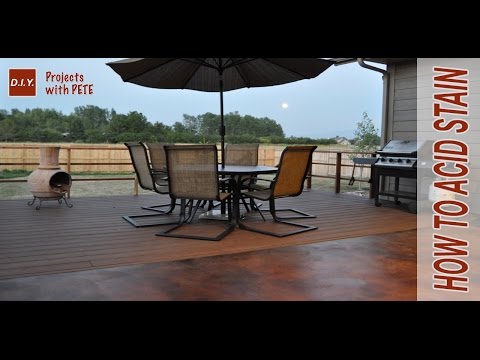
How to Acid Stain Concrete. In this video DIY PETE will walk you through the process of staining a concrete patio. This is a great weekend project that is simple and affordable. Your boring grey concrete will transfrom into a beautiful area of your home.
For more info, project photos, and downloadable plans check out:
http://www.diypete.com/howtoacidstain
Degrease and Remove Stains / Paint
Use a power washer to do an initial cleaning of the concrete. Once wet, you’ll be able to see if there are problem areas of oil, paint, or grease. You will want to remove any paint or oil because acid stain will not “TAKE” or “REACT” with the concrete in those areas.
Paint is somewhat tough to remove. Try using a paint remover in combination with a razor blade or wire brush first. If this does not work, try using an orbital sander. The concrete will look slightly different where you’ve used these tools, but will look much better than it would if there were paint or grease areas.
Tape and Mask
After cleaning and letting the area dry up, you’ll want to tape and mask siding, trim, doors, and any other surfaces you don’t want to get stain on.
Prepare Acid Stain
Pour acid stain into a pump sprayer. For this patio, I used Dark Walnut by Scofield Chemstain. This gave the concrete a natural brown color. You can use a highlight color if you’d like to mix another color in a separate sprayer. This is not necessary. I highlighted mine with Quikrete Coffee Acid stain.
I would recommend diluting the acid stain according to the manufacturers instructions. I mixed mine about 1 part stain to 1 part water. Remember you can always add additional coats to darken the stain. You cannot lighten a stain, which is why I prefer diluting the stain and doing multiple coats to give me a little more control over how dark the stain will be.
Wet the concrete
Before applying acid stain, I’d recommend misting the entire surface with water. You don’t want too much that it puddles, but the entire surface should be saturated. This helps the stain go on more evenly and also makes the staining process a little more forgiving. For instance, if you accidentally get a drop of acid stain on dry concrete it is going to leave a more noticeable spot. If the concrete is wet, it will help it blend a bit more. I used an additional pump sprayer for this process.
Apply Acid Stain to Concrete
Use a pump sprayer to apply the acid stain. Apply enough to saturate the concrete but not to puddle. Apply in a zig-zag type motion to give it variation and a random look as opposed to applying in straight lines. (See the video for a better description). Do not walk on the acid stain once it is applied or you’ll have footprints in the final product. If you’d like a more uniform finish with less variation, a second person can use a shop broom to help brush the stain into the concrete immediately after you’ve sprayed the stain.
Applying the second coat of stain to darken the concrete up a little more. Allow the stain to dry for a full 8 hours or overnight before neutralizing the stain. This will ensure the stain penetrates into the surface completely.
Neutralize Acid Stain
Neutralize the stain using Ammonia and water once the stain has dried for at least 8 hours. I’d recommend using 2 cups of ammonia per 5 gallon bucket of water. Once neutralized, the acid will no longer react.
Apply Sealer
Seal the concrete. I like to use solvent based sealers for concrete patios, but you are welcome to use water-based if you’d prefer. I’ve found H&C concrete sealer to work well for outdoor applications. The Clear Gloss version gives the stain a rich color / wet look and is super durable. I’ve also had good luck using SuperSeal 2000 which is available on Amazon. Make sure you don’t seal when the temperature is above the recommended sealing temperature set by the manufacturer. Bubbling of the sealer is one problem that can occur if sealed when the concrete is too hot. If you are sealing the concrete with a roller and bubbles are forming, you can get rid of bubbles by running a brush over the problem areas.
—-
Looking for more DIY videos? Be sure to check out our channel and subscribe for updates! We post a weekly tutorial every Thursday.
Looking for woodworking, concrete working, and other DIY projects plans to follow? You can download plans for free at http://gumroad.com/DIYPETE
Facebook: http://facebook.com/DiyProjectsWithPete
Instagram: http://instagram.com/diypete
Pete Sveen
1627 W Main Street Suite 182
Bozeman, Montana 59715
)
what are the names of the stain maker, and sealer maker please???
what would u estimate all those supplies be to do this particularly the acid stain
They stained and sealed my backyard patio but was not satisifed with the results. Can I re-apply the acid stain on my patio?
can i do this to craked/rough concrete
Question for ya:
Could you use two different stain colors together?
thanks
If my patio was already stained is there another step to remove the original stain or can I just stain over the original stain?
I think I want to do a multi colored calico patio. A base color light sandstone, some sort of red and a chocolate or cocoa color random blotches. (20×20 area)…. Will one color give me the variegated look I want or is the concrete going to give me a solid color appearance. I definitely do not want the look of a solid "color added" concrete slab. I want assorted hues of tans, reds, browns.
Hi pete, thanks for uploading this video. I have a question. Can you apply this acid stain on normal concrete that is allready in the house? or do you need to put first another kind of concrete on the normal concrete floot thats already there? I am sorry for my bad english. kind regards alicia
Would mixing 2 or more constrations work? or even 2 different colors of stain work? Larger rollers can be used to reduce time.
I've watched numerous videos to learn how to acid-stain my kitchen floor properly. This one, by far, offers the clearest instructions on how to do the job. Thanks for uploading an informative video that was fun to watch.
Pete great video! I have oil stains any recommendations on how to putt them out or beat them in deep enough for acid to still stain? Also if I just power wash and etch will the stain just be darker over the oil spots? Thanks keep up the good work!
Very nice! Good job and helpful tutorial!
And thank you so much for the other answers..
I'm sorry for all the questions I just have one more is it better to use a sprayer for the sealer or the roller the reason why I was asking is because I was thinking if I use a roller I will have to use more gallons of sealer?
And also was wondering what kind of pump spray would be good to get I've looked at some but there's so many different ones and different reviews
Hi I've applied the acid stain the only thing is I'm not sure what roller I'm supposed to use for the concrete sealer can you help please thank you
Great video, Pete. On newly poured concrete is that full cleaning process, i.e. the degreaser still necessary?
I've been looking to do this long time ago but I don't now how, with your video I'm sure that I can do it now, Thank you very much. I love it! great job
Thanks for the video! I would like to use this process on my basement floor.. are there any adjustments that you would suggest? Should I be concerned about fumes in the house at all?
Man, that looks great. Wife and I are looking at doing something similar to our indoor floors. Thanks for an informative overview.
I just suscribe… two questions one can it be use inside ???? Two what can I use to make it shinier ??? Thanks keep up the good work
does anyone know if you can stain self leveling compound . ??
about how much in products for the job?
Dude, killer video, exactly what I needed! I just put down the first coat and can't want to see the finish project. Thanks a million!
this is so nice! thanks for your videos!
Great video. Would an acid stain stand up to the abuse on a driveway? Thanx again great video.
Hi Pete,
After I cleaned the concrete, it failed the water absorption test. Do you recommend etching the concrete or will the acid stain still absorb into the concrete?