Nutella Bread Recipe: https://www.youtube.com/watch?v=8eHPkpCGdEY
Watch more Basic Plumbing videos: http://www.howcast.com/videos/513654-How-to-Solder-a-Pipe-and-Fix-Water-Lines-Basic-Plumbing
Okay. Let’s talk about fixing water lines. Depending on what region of the country you’re in, you may see PEX tubing, which is a type of plastic or something, but in the five boroughs of New York City it is exclusively copper. If it’s not, you’re not legal. So this is what we call half-inch, indicating the size of the pipe, half-inch type L. L is the indicator of whether you can use it for potable water, potable being clean, domestic drinking water, showering water. Okay. This is what you see throughout the city, under your sinks, everything else. This is a fairly thick-walled copper pipe, and it’s easy to repair unless you have something bad happen.
But generally speaking it’s easy to repair. Now for the purpose of this video I’m going to show you how to solder a 90, okay, also known as an L, which is a very small fitting. This would be, for example, let’s say we installed a new vanity or a kitchen cabinet. You’d have a raw copper pipe coming out like so. All right. And then you’d need to put a joint in there of some sort. It might be an L going up like so and then a valve that would shut off the supply to your sink. Okay. So for this purpose I’m just going to solder this 90. I’m going to show you how to properly do it. Ask any plumber how to solder, and you’ll get any number of different stories on how to do so. This is is how I solder, not necessarily saying it’s the Bible way to solder, but this is how I do it, and it’s worked for me for 20 years as a Master Plumber. You need a few things. An emery cloth, this is basically sandpaper, but it’s a strip. You need a fitting brush. This is a half-inch fitting brush. You need silver solder. Be careful not to get lead. It says very clearly 95 percent/5 percent. And your trusty torch.
So we start by cleaning the joints to be soldered. Okay. In this case we’re going to use these two pieces of pipe. You just kind of wrap it around, and you’re going to clean it. Be judicious with the cleaning. Okay. I don’t want to see any black marks on that recently sanded pipe. That’s carbon. That will cause a leak. That’s another reason I’m wearing gloves. People might call me a primadonna for doing so, but it actually keeps the oils in your hands off of the joint. This is not conducive to soldering. The oils in your hands are not conducive to soldering. So now we’re going to take our fitting and our fitting brush, okay, just a wire brush. This one’s kind of beat up, but it will still get the job done. Again same idea, you twist it around in there until you can see your reflection. So we’ve got a nice, clean 90-degree elbow. The next thing you want to do, again the gloves come in, they’re very imperative here.
No oils from your fingers going onto these joints. The only thing you want on these joints is acid paste, otherwise known as flux. Okay. The purpose of this, and you don’t have to be too liberal. This is called an acid brush. The purpose of flux in general is when you heat the pipe to pull the silver solder into the joint. Okay. Don’t ask the physics on how that works. That’s just how it works. So I generally start with the fitting first. And you just need a film of it, just a little film. You don’t need to paint a Picasso doing this here. So we’ve got the joint fluxed. We just kind of pass around the edge. Okay. We’re doing a half-inch joint, so really all you need is a half-inch of flux. Okay. We don’t need a ton, a big, messy, ugly pasty joint. And this stuff is all that great to get on your hands, too. We’ve fluxed everything now. I’ve got my joint together. This could be an offset in a wall. It could be anything. For any reason I could be doing this.
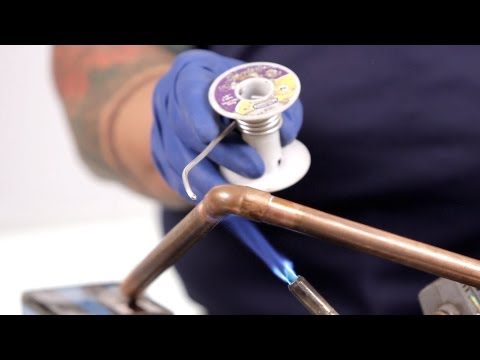
So now I’m ready to apply heat and actually solder the joint. Again when you’re using a torch, always have the fire extinguisher handy, especially if you’re not a professional. Yes, I know how to use the torch better than most people that do not use it every day, but I still have a fire extinguisher right over within five feet of me. Okay. So keeping in mind now when we activate the flame on this, we don’t need to blast it with as much flame as we can possibly get. There is a regulator right here that I can adjust that flame. This is an excessive flame for half-inch. It’s too much heat. It will heat up too fast, and you’ll see the joint actually smoke. That’s not necessary. I’m only soldering half-inch. This would be a more appropriate flame for three-quarter or one-inch or something like that. So I’m going to turn this down. You can hear it. Now I’ve got my silver solder. One of my little quirks, I like to actually drag t
)
If you need good plumbing service, just call us 855-513-625
i always use too much solder and heat. me thinking its not enough and not knowing its being pulled in by the flux. great vid
"leave the joint alone! you see so many guys in there bashing at it with flux or wiping it with a rag"
>immediately hits it with more flux, then wipes it with a rag
Thanks, man! I wish I would have watched this before diving right in on a couple of home repairs.
Do you need to solder around the entire joint (360 degrees)? Never done any of this before
Thank god for Pex
sanding your solder for impurities? WTF? I bet that first joint you did would have leaked.
10 bucks says there's no fire extinguisher….
I hate christians they are only bossy but not like christs just a hypocricys
so little of that stuff he putted whn he welded it
Perfect instruction. Many thanks for posting this.
Nice job. Really appreciate the insights. Will make my little home plumbing job much better.
thank you good tips…
THANX!!..im going to relocate a water heater and re-route the water pipes and this was the only part i wasn't sure about…new sub💯🍻
I finaly decided what i want to do with my life i wanna be a plumber
What do you think of the sharkbite fittings? Are they as reliable than soldering?
Cool. Awesome tutorial, thanks!!!
Best solder video available. Good work. Thanks
Thanks for the video. What do you think of the brass systems that are non welding, they make fittings that are faster to install, however my question is what is the life expectancy (they say 20 to 25 yrs) compared to soldering? Thank you in advance for your answer.
Ah, good old NYC, the land of regulations designed to protect the interests of fat cats and prevent the "little guy" from performing simple, effective work using PEX.
first timer here : skeptical on getting solder all the way around fitting because of tight space. Is it possible to reheat and add more solder
Great intro video. Very helpful.
Buy the RIDGID 122XL and your life will be alot easier.
His chub n' tuck is 10/10 Ethan would be proud.
very helpful thank you
Okay, I've been using too much solder. Nice presentation.
Great! thanx #HansenPlumbing
Much of the rules, like getting a joint completely clean or as he puts it carbon free, are nearly an impossible feat in super tight quarters. Also torching above your head maybe necessary if that's the only angle to the leak point or joint. There's plenty of ways to take caution and avoid the droplets. Also notice he's using a MAPP tank (yellow) when most of us mere economical mortals would go with a $3 propane tank (blue). Takes much longer to heat things up that way so a bigger flame is sometimes necessary and remember to concentrate the heat from the very tip of the blue flame for best results.